

The Role of 16-Inch 8K Mono LCD Displays in High-Precision Optical Systems

Introduction: The Growing Demand for Ultra-High-Resolution Mono Displays
As advanced manufacturing technologies continue to evolve, display components are playing an increasingly critical role in system-level performance. In sectors such as industrial 3D printing, optical inspection, and precision exposure equipment, the focus has shifted from traditional color visualization to functional light modulation and pixel-level accuracy.
Within this context, 8K mono LCD displays have emerged as a key enabling technology. Unlike consumer-grade color panels, mono LCD screens are engineered to maximize effective resolution, grayscale precision, and optical efficiency. These characteristics are essential for applications where each pixel directly affects physical output.
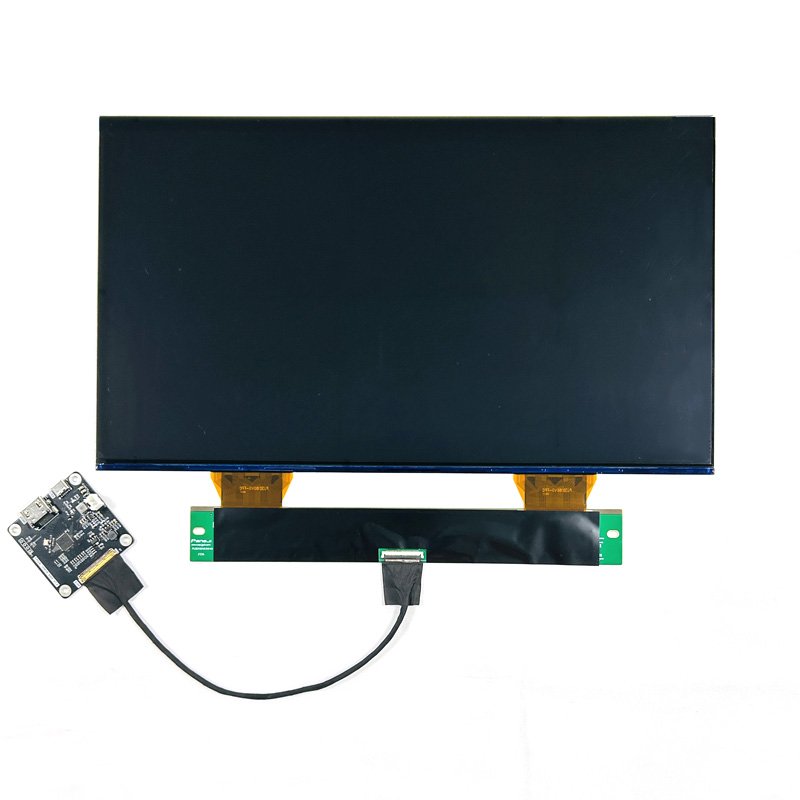
A representative example of this trend is the 16-inch 8K (7680×4320) mono LCD, which combines a large active area with extreme pixel density, supporting next-generation precision systems that demand both scale and accuracy.
Understanding Mono LCD Technology at 8K Resolution
What Defines a Mono LCD Display?
A mono LCD, or monochrome LCD, is designed without RGB color filters. Each pixel functions as a single light-controlling unit, allowing the panel to achieve:
- Higher effective resolution compared to color LCDs
- Improved light transmittance
- More accurate grayscale rendering
- Reduced optical loss in projection systems
These properties make mono LCD displays particularly suitable for resin-based 3D printing, exposure systems, and optical pattern generation, where uniform light control is far more important than color reproduction.
Why 8K Resolution Matters in Industrial Applications
An 8K resolution of 7680×4320 pixels on a 16-inch panel delivers exceptionally high pixel density. For system designers, this translates into measurable advantages:
- Finer feature definition
- Higher dimensional accuracy
- Reduced aliasing effects
- Larger usable working areas without sacrificing resolution
In practical terms, 8K mono LCD technology allows equipment manufacturers to scale up build volumes or exposure areas while maintaining micro-level precision.
Industrial Drivers Behind Large-Format 8K Mono LCD Adoption
High-Precision 3D Printing Systems
One of the most important application areas for large-format 8K mono LCD displays is industrial resin 3D printing, including SLA, MSLA, and DLP-like architectures.
As 3D printers evolve toward larger platforms and higher throughput, display resolution becomes a limiting factor. A 16-inch 8K mono LCD enables:
- Larger build areas with consistent XY resolution
- Smoother surface finishes
- Improved edge sharpness
- More uniform exposure across the platform
These benefits are particularly relevant in industries such as dental manufacturing, medical modeling, precision tooling, and high-detail prototyping.
Optical Inspection and Pattern Projection
Beyond additive manufacturing, high-resolution mono LCD panels are widely used in optical inspection and projection-based systems. In these applications, grayscale stability and pixel uniformity directly affect measurement accuracy and repeatability.
Large-format mono LCDs support:
- Accurate pattern projection
- Reliable optical alignment
- Consistent grayscale transitions for image analysis
The absence of color filters ensures cleaner optical output and predictable system behavior.
Signal Control and Display Driving in 8K Mono LCD Systems
As resolution increases, the complexity of signal transmission and display driving also grows. In large-format 8K mono LCD systems, the control board plays a crucial role in ensuring stable image output and precise synchronization.
In professional 3D printing and optical systems, a dedicated HD-MI to eDP display control board is commonly used to manage high-bandwidth data transmission between the host system and the mono LCD panel. A practical example is the
HD-MI board for mono LCD displays,
which is designed to support high-resolution mono panels used in 3D printer control architectures.
By pairing an 8K mono LCD with a suitable display control board, system integrators can achieve:
- Stable frame output
- Accurate grayscale mapping
- Reduced signal interference
- Simplified system integration
This combination is essential for maintaining consistent performance in high-resolution printing and exposure environments.
The Role of UV Light Systems in Mono LCD-Based Printing
Light Source as a System-Level Component
In resin-based 3D printing, the mono LCD does not operate in isolation. Its performance is closely linked to the characteristics of the UV light system responsible for material curing.
Key factors include:
- Wavelength stability
- Illumination uniformity
- Thermal management
- Long-term output consistency
Without proper matching between the display and the light source, even the highest-resolution mono LCD cannot deliver optimal results.
UV Light Systems for Large-Format Exposure
In professional and industrial 3D printers, large-format mono LCD panels are typically paired with UV light systems designed for uniform exposure across wide areas. An example of such a component is
UV light systems for mono LCD curing applications.
When combined with a 16-inch 8K mono LCD, a properly designed UV light system helps ensure:
- Consistent layer curing
- Reduced edge distortion
- Improved surface quality
- Stable operation during extended production cycles
This display–light integration is a defining characteristic of modern high-resolution resin printing platforms.
Technical Considerations for 16-Inch 8K Mono LCD Panels
Pixel Uniformity and Grayscale Accuracy
For large-format mono LCDs, maintaining uniform pixel response across the entire active area is critical. Industrial-grade panels are engineered to minimize pixel variance and support stable grayscale output, even during long operating hours.
Thermal Stability and Reliability
High-resolution mono LCD panels used in industrial systems must withstand continuous operation. Thermal stability and predictable aging behavior are therefore key selection criteria, particularly in enclosed or high-intensity optical environments.
Interface and System Compatibility
Unlike consumer displays, industrial mono LCD panels are designed for integration into custom optical and control systems. Compatibility with FPGA-based controllers, dedicated driver boards, and industrial software platforms is essential for long-term deployment.
A Practical Reference: 16-Inch 8K Mono LCD Screen
The industry trends discussed above are reflected in solutions such as the
16-inch 8K 7680×4320 mono LCD screen,
which is developed for applications requiring ultra-high resolution, large exposure areas, and stable optical performance.
Panels in this class are increasingly used as core components in advanced 3D printing systems and precision optical equipment, where display quality directly influences final output.
Market Outlook: From Component to Core Technology
As manufacturing processes continue to demand higher precision and scalability, mono LCD displays are transitioning from niche components to core enabling technologies. The growth of large-format 8K mono LCD panels reflects broader trends toward system-level optimization rather than isolated performance improvements.
Manufacturers and system integrators are increasingly evaluating displays not only by resolution, but also by how well they integrate with control electronics, light sources, and long-term production requirements.
Conclusion: 8K Mono LCD Displays Enabling Next-Generation Precision Systems
The adoption of 16-inch 8K mono LCD technology marks a significant step forward for industries that depend on precision light control and high-resolution output. From industrial 3D printing to optical inspection and exposure systems, large-format mono LCD panels provide the foundation for more accurate, scalable, and reliable equipment.
As demand for higher resolution and larger working areas continues to grow, 8K mono LCD displays are set to play an increasingly central role in the development of next-generation precision systems.