

How to Choose a UV Light Meter for LCD Testing in Resin 3D Printers

Introduction
In resin 3D printing systems, exposure accuracy depends on the ability to control and verify ultraviolet light delivery through the LCD panel. As print resolutions increase and build areas expand, small variations in UV exposure can lead to significant differences in curing behavior. To evaluate and control these variations, a UV light meter is widely used as a practical measurement tool.
Choosing the right UV light meter for LCD testing is not trivial. Different meters vary in wavelength response, sensor design, and measurement stability. Selecting an inappropriate device can result in misleading data, making exposure problems harder—not easier—to diagnose.
Why UV Light Meter Selection Matters in LCD-Based 3D Printing
Unlike visible-light displays, resin 3D printers operate primarily at a narrow ultraviolet wavelength band centered around 405nm. Exposure performance is determined by how evenly and consistently this UV energy is delivered through the LCD.
A UV light meter used for LCD testing must therefore:
- Accurately respond to 405nm UV light
- Provide stable readings across repeated measurements
- Allow precise positioning on the LCD surface
If any of these requirements are not met, measurement results may not reflect actual curing conditions.
Understanding the Measurement Task
Before selecting a UV light meter, it is important to understand the specific testing task involved in resin 3D printing.
Typical LCD exposure testing includes:
- Measuring UV intensity at multiple locations
- Comparing center and edge exposure
- Identifying asymmetrical distribution patterns
- Tracking exposure degradation over time
These tasks require spatial consistency and repeatability rather than single-point peak measurements.
Wavelength Sensitivity: The Most Critical Parameter
The most important specification of a UV light meter for resin 3D printing is its wavelength sensitivity. Most photopolymer resins are optimized for curing at approximately 405nm, and exposure outside this range contributes little to polymerization.
A meter that is not spectrally matched may:
- Underestimate or overestimate true curing energy
- Respond to irrelevant visible light components
- Produce inconsistent readings across environments
For accurate LCD testing, a 405nm UV light meter is essential.
Sensor Size and Measurement Resolution
LCD exposure testing typically involves placing the sensor directly on or just above the LCD surface. Sensor size therefore plays an important role in measurement resolution.
Smaller sensors allow:
- More precise localization of intensity variations
- Better mapping of small LCD panels
- Improved detection of localized defects
Larger sensors may average light over a wider area, masking small but significant non-uniformities.
Repeatability and Measurement Stability
For diagnostic and maintenance purposes, repeatability is often more important than absolute accuracy. A UV light meter should provide consistent readings when measuring the same location under identical conditions.
Poor repeatability makes it difficult to:
- Compare measurements over time
- Evaluate the effectiveness of repairs
- Establish performance baselines
Stable, repeatable output is therefore a key selection criterion.
Measurement Workflow Compatibility
A practical UV light meter must integrate smoothly into real-world testing workflows. This includes considerations such as:
- Ease of handling inside the printer enclosure
- Clear display or data output
- Minimal sensitivity to ambient light
Meters designed for laboratory or outdoor use may not perform well in the confined optical environment of a 3D printer.
Common Mistakes When Choosing a UV Light Meter
Several common mistakes are often made when selecting a UV light meter for resin 3D printing applications:
- Using visible-light lux meters instead of UV-specific sensors
- Selecting meters without verified 405nm calibration
- Prioritizing peak sensitivity over spatial consistency
- Ignoring sensor geometry and placement constraints
Avoiding these mistakes helps ensure that measurement data reflects actual exposure behavior.
Using a UV Light Meter for LCD Exposure Mapping
Once a suitable UV light meter is selected, it can be used to create an exposure map of the LCD panel.
A typical mapping process involves:
- Removing the resin vat
- Activating a full-field exposure
- Dividing the LCD into a grid
- Measuring UV intensity at each grid point
- Comparing results to identify non-uniformity
This process provides actionable data for diagnosing exposure-related issues.
Supporting Preventive Maintenance with UV Measurements
Beyond initial diagnostics, a UV light meter supports preventive maintenance strategies by enabling trend analysis.
Regular measurements can reveal:
- Gradual exposure decline
- Increasing edge attenuation
- Asymmetrical degradation patterns
These trends often indicate aging LCD panels or thermal stress before print quality visibly deteriorates.
Application in Manufacturing and Quality Control
In printer manufacturing environments, UV light meters are often integrated into quality control procedures.
Typical use cases include:
- Incoming LCD inspection
- Final exposure validation
- Post-repair verification
Consistent measurement standards help ensure that multiple printers perform within defined exposure tolerances.
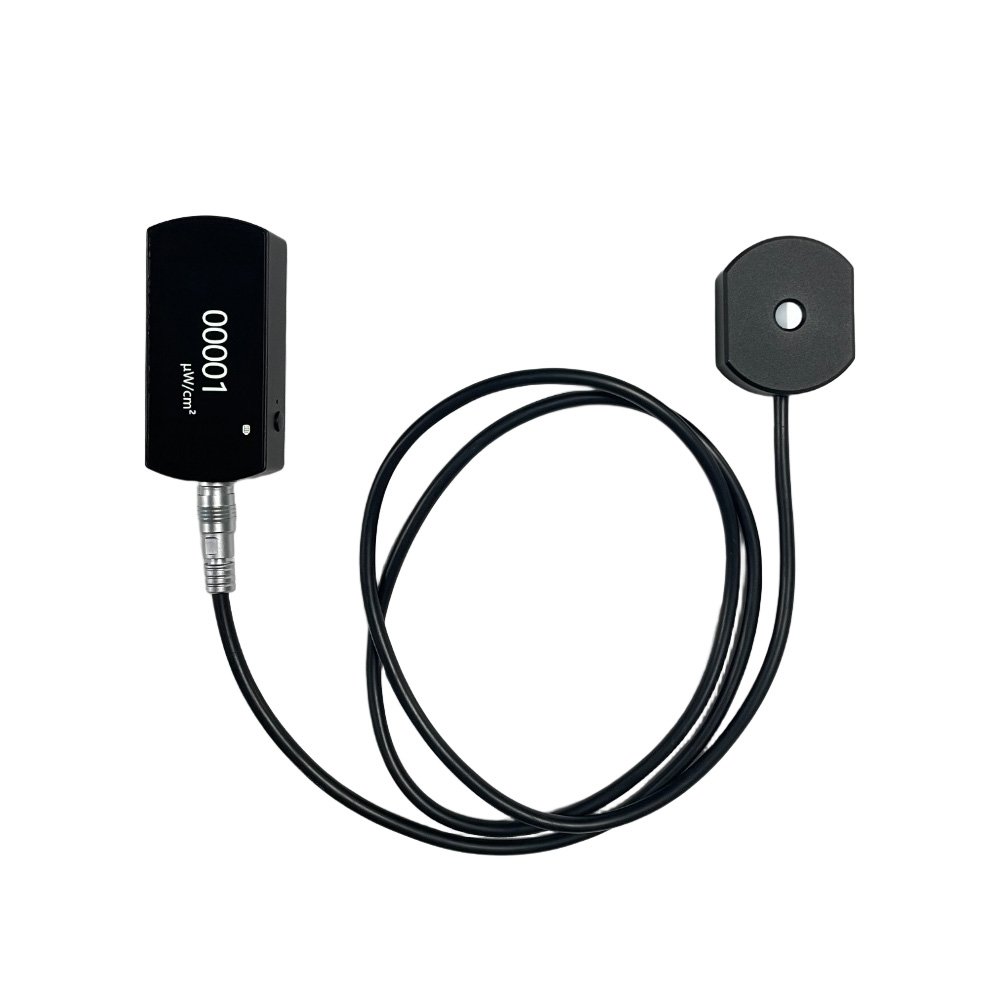
UV light meter for 3D printers
Data Interpretation Considerations
When interpreting UV light meter data, it is important to focus on relative differences rather than isolated values.
Key questions include:
- How does edge intensity compare to center intensity?
- Are there directional trends across the LCD?
- Do measurements change over time under identical conditions?
These comparisons provide deeper insight than absolute intensity numbers alone.
Importance of Calibration and Long-Term Accuracy
A UV light meter should maintain calibration stability over its service life. Drift or sensitivity changes can compromise long-term analysis and trend tracking.
For LCD exposure testing, calibration stability is particularly important because:
- Changes are often gradual
- Decisions may depend on small variations
- Data is compared across months or years
Selecting a meter designed for long-term consistency reduces uncertainty.
Selecting Tools for 405nm Exposure Verification
Because resin curing efficiency is wavelength-dependent, selecting tools specifically intended for 405nm UV measurement ensures relevance and reliability.
A 405nm UV light meter provides confidence that measured values directly correspond to curing performance rather than unrelated optical artifacts.
Conclusion
Selecting the right UV light meter is a foundational step in effective LCD exposure testing for resin 3D printers. A well-matched meter enables accurate diagnosis of exposure problems, supports preventive maintenance, and improves long-term print reliability.
By understanding wavelength requirements, sensor characteristics, and workflow compatibility, users and manufacturers can choose UV light meters that deliver meaningful, actionable data and support consistent curing performance across the entire LCD surface.