

How 10.1 inch 16K Mono LCD Enables Large Resin 3D Printing

How 10.1 inch 16K Mono LCD Enables Large Resin 3D Printing
The Growing Demand for Large Resin 3D Printing
Over the past decade, resin 3D printing has evolved from a niche prototyping method into a powerful manufacturing tool used in multiple industries. Early desktop printers focused primarily on small objects such as jewelry prototypes or dental models. However, as additive manufacturing technologies matured, the demand for larger build volumes has grown significantly.
Manufacturers, designers, and engineering teams now expect resin printers to produce bigger parts while maintaining extremely fine detail. This expectation has pushed display manufacturers to develop higher-resolution LCD panels capable of supporting larger printing areas.
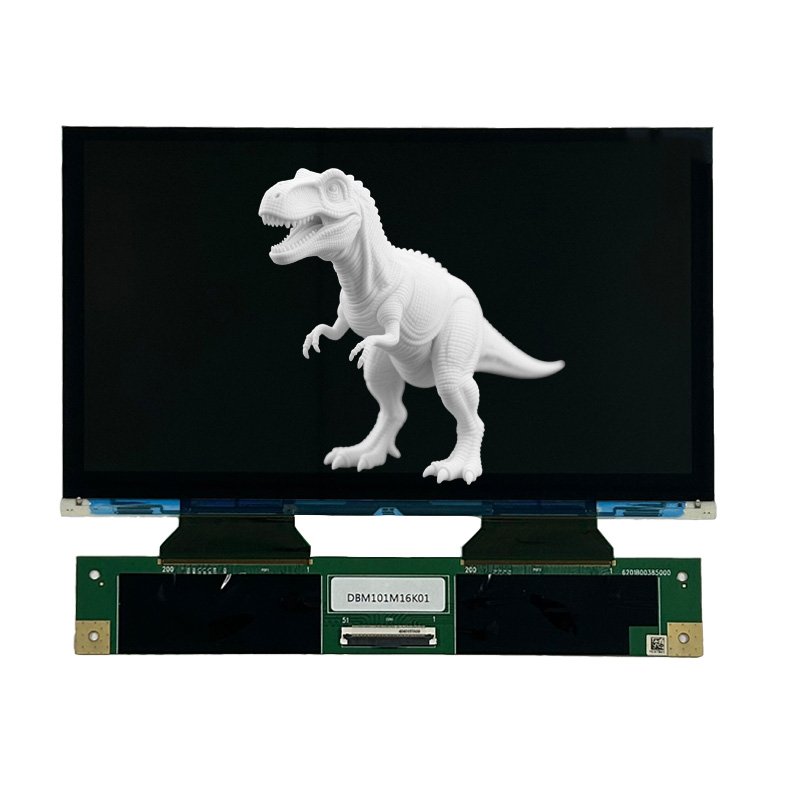
One of the newest solutions emerging in this space is the 10.1 inch 16K mono LCD, which combines a large display size with extremely high pixel density. By dramatically increasing resolution while expanding the display area, this type of screen allows resin printers to maintain microscopic detail even when producing larger objects.
As a result, ultra-high-resolution LCD panels are quickly becoming a key component in the next generation of professional resin printing systems.
Why Screen Size Matters in Resin Printing
In LCD-based resin printers, the display panel determines two critical aspects of the printing process:
- Build area
- Pixel size
The physical size of the screen directly defines the maximum printing area available inside the machine. A larger screen allows manufacturers to design printers capable of producing bigger parts or multiple components simultaneously.
However, increasing the screen size alone introduces a major challenge. If the resolution does not increase proportionally, each pixel becomes larger. Larger pixels reduce print accuracy because each pixel represents a larger portion of the printed layer.
This is why simply installing a larger LCD panel is not enough to improve printer performance. Resolution must also increase in order to maintain high precision.
High-resolution displays solve this problem by dramatically increasing the number of pixels across the screen. Technologies like the 10.1 inch 16K mono LCD enable manufacturers to expand the build area while still preserving extremely small pixel sizes.
The Advantage of Ultra-High Pixel Density
One of the most important characteristics of a modern LCD printing screen is pixel density, which refers to how many pixels are packed into a specific area of the display.
Higher pixel density provides several benefits for resin printing:
Greater Detail Accuracy
Smaller pixels allow printers to reproduce fine textures, sharp edges, and complex geometries.
Smoother Surface Finish
Higher resolution reduces visible layer artifacts, producing smoother surfaces on printed parts.
Improved Dimensional Precision
With smaller pixels controlling the exposure area, the final printed dimensions become more accurate.
Better Multi-Part Production
High-resolution displays allow printers to produce many smaller parts simultaneously while maintaining consistent quality across the entire build platform.
Screens such as the 10.1 inch 16K mono LCD represent a significant leap forward in pixel density compared with earlier 4K or 8K displays used in resin printers.
Supporting Large Industrial Printing Applications
The ability to print large, detailed objects has expanded the range of industries adopting resin printing technologies.
Large-format resin printers are now used in:
Dental Production
Dental labs often need to print large batches of models simultaneously. High-resolution displays enable consistent accuracy across multiple parts in a single print job.
Jewelry Manufacturing
Jewelry casting requires extremely fine detail for intricate designs. High-resolution LCD displays allow larger casting trees to be printed while maintaining micro-level precision.
Product Design and Prototyping
Engineers frequently need full-scale prototypes to evaluate product ergonomics or assembly fit. Larger printing volumes reduce the need for segmented prints.
Collectible and Figurine Production
Artists producing miniatures and collectibles benefit from printers capable of producing multiple models simultaneously with high detail quality.
Large-format screens play a key role in enabling these applications.
For example, ultra-high-resolution displays such as the
10.1 inch 16K mono LCD screen
allow resin printers to maintain fine pixel accuracy across a wide build area.
Improving Printing Efficiency for Production Workflows
Beyond resolution and build volume, modern LCD displays also influence production efficiency.
In professional environments, printers are often used continuously throughout the day. Reducing print times while maintaining accuracy is essential for increasing throughput.
Mono LCD technology helps achieve this goal in several ways:
Faster UV Transmission
Because mono LCD panels do not include RGB color filters, they allow more ultraviolet light to pass through the screen.
Shorter Layer Exposure
Higher UV transmission means each resin layer cures faster.
Reduced Heat Generation
More efficient light transmission produces less heat, which improves system stability.
Longer Display Lifespan
Mono LCD screens are designed to tolerate prolonged UV exposure, extending their usable life compared with RGB displays.
These improvements help printers operate more reliably in production environments where machines run for extended periods.
The Role of High-Speed Data Interfaces
As display resolution increases, the amount of image data required to control each layer also grows dramatically.
For example, a 16K display contains tens of millions of pixels that must be refreshed for every printed layer. Managing this data requires high-speed communication between the printer’s control board and the display.
Modern LCD screens address this challenge through advanced interfaces such as MIPI transmission systems. These high-bandwidth interfaces enable printers to deliver extremely detailed layer images to the display without delays.
Displays like the
10.1 inch 16K mono LCD
are designed to support high-speed image transmission, ensuring stable printing even during complex jobs that involve thousands of layers.
Efficient data communication is essential for maintaining print accuracy and preventing exposure inconsistencies.
FAQ: Large Format Resin Printing Displays
Why do large resin printers need high-resolution LCD screens?
Larger screens increase the build area, but without higher resolution, pixel sizes become larger. High-resolution displays maintain small pixel sizes and preserve print detail.
What advantages do mono LCD screens offer?
Mono LCD screens provide higher UV transmission, faster curing speeds, lower heat generation, and longer display lifespans compared with RGB panels.
Does a larger LCD always mean better printing quality?
Not necessarily. Larger screens must also have high resolution to maintain small pixel sizes. Otherwise, print quality may decrease.
Why are 16K LCD displays becoming popular in resin printing?
16K displays offer extremely high pixel density across large screen sizes, allowing printers to produce detailed objects without sacrificing build volume.
Conclusion
The evolution of resin 3D printing technology is closely tied to advances in display technology. As users demand larger build volumes without sacrificing precision, display manufacturers have responded with increasingly sophisticated LCD solutions.
Ultra-high-resolution screens such as the 10.1 inch 16K mono LCD demonstrate how modern display technology can balance screen size, pixel density, and transmission efficiency. These improvements allow resin printers to produce larger parts while maintaining the fine detail required for professional applications.
As additive manufacturing continues expanding into industrial production environments, high-resolution mono LCD displays are expected to remain one of the most important components shaping the future of resin printing systems.