

Complete 9K LCD Solution for Resin 3D Printer Systems

Complete 9K LCD Solution for Resin 3D Printer Systems
In resin 3D printing, achieving high precision and consistent results depends on more than just a high-resolution screen. Modern MSLA printers require a fully integrated system where the display, signal control, and light source work together seamlessly.
For manufacturers developing next-generation machines, adopting a complete LCD solution is the most effective way to ensure performance, reliability, and scalability.
A typical high-performance system includes:
- A 9K high-resolution mono LCD
- A stable HD-MI to MIPI controller board
- A uniform and efficient UV light source
When these components are properly matched, they form a synchronized imaging system that directly determines print quality and production efficiency.
Why a Complete LCD Solution Is Critical
Many common printing issues are not caused by a single component, but by poor integration between components. These include:
- Inconsistent curing across the build area
- Signal instability or image distortion
- Reduced resolution performance
- Shortened component lifespan
A complete solution addresses these challenges by ensuring compatibility at both the electrical and optical levels.
Instead of treating the LCD, controller board, and light source as separate parts, a system-level approach ensures that all elements operate in harmony.
Core Component 1: 9K MIPI Mono LCD Display
At the center of the system is the display, which defines the achievable resolution and detail.
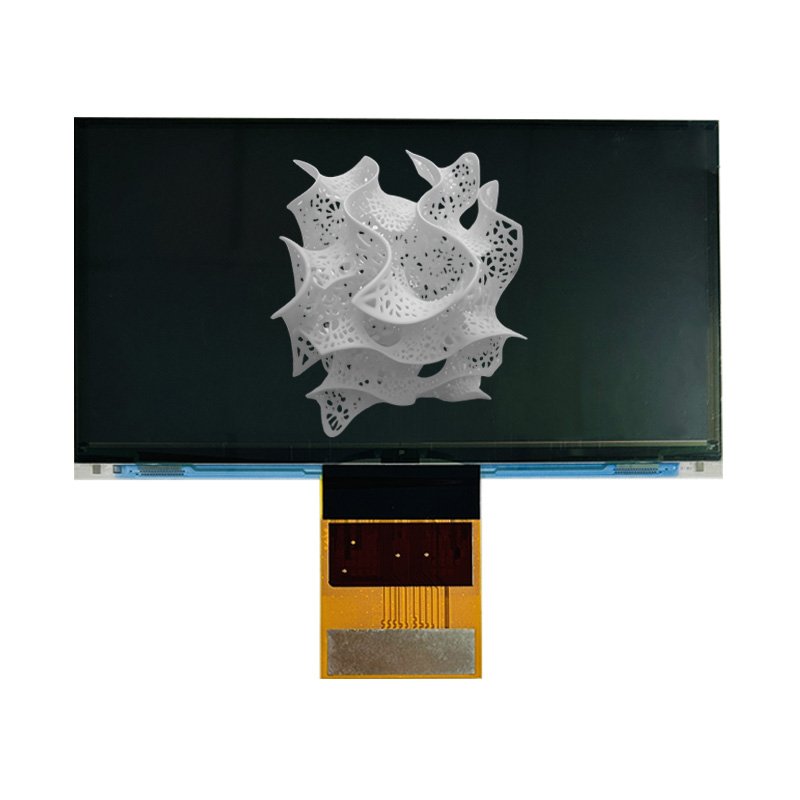
9K MIPI mono LCD for resin 3D printers
With a resolution of 8520 × 4320, a 9K LCD significantly improves pixel density, allowing for:
- Ultra-fine feature reproduction
- Smooth surface finishes
- Higher dimensional accuracy
Compared with lower-resolution displays, 9K panels reduce visible layer lines and enhance overall print quality.
Why Monochrome LCD Is Preferred
Monochrome LCDs are widely used in resin printing due to their superior performance compared to RGB panels. Key advantages include:
- Higher UV light transmittance
- Faster curing speed
- Longer operational lifespan
These characteristics make mono LCDs essential for high-efficiency and professional-grade printing systems.
Core Component 2: HD-MI to MIPI Controller Board
To operate a MIPI LCD in a 3D printer, signal conversion is required.
HD-MI to MIPI controller board for 3D printing
Most printer motherboards output HDMI signals, while high-resolution LCD panels rely on MIPI interfaces. The controller board acts as a bridge between these two standards.
Functions of the Controller Board
A high-quality controller board performs several critical functions:
- Converts HDMI signals into MIPI DSI format
- Maintains high-speed data transmission
- Synchronizes image output with display timing
- Ensures stable operation during long print cycles
Impact on System Stability
Without proper signal conversion, the system may experience:
- Screen flickering
- Layer misalignment
- Data loss or distortion
A reliable controller board ensures that the full resolution and performance of the LCD panel can be utilized without compromise.
Core Component 3: UV Light Source System
The UV light source is responsible for curing resin and directly affects print consistency.
UV light source for resin 3D printers
Why Light Uniformity Matters
Even with a high-resolution LCD, poor light distribution can result in:
- Uneven curing
- Warping or deformation
- Weak structural integrity
Uniform illumination across the entire build area is essential for achieving consistent results.
Benefits of a Matched UV System
An optimized UV light source provides:
- Consistent intensity across the panel
- Proper wavelength for efficient curing
- Reduced exposure times
- Improved layer adhesion
This ensures that each projected image is accurately translated into a solid layer.
How the System Works Together
A complete 3D printing display system operates through a coordinated process:
- The motherboard outputs image data via HDMI
- The controller board converts the signal to MIPI
- The LCD panel displays the layer image
- The UV light cures the resin accordingly
This synchronized workflow ensures:
- Accurate layer-by-layer reproduction
- High-speed printing
- Stable long-duration operation
Advantages of an Integrated 9K LCD Solution
Higher Precision
The 9K resolution enables extremely fine detail, suitable for demanding applications.
Improved Efficiency
Fast signal transmission and curing reduce overall print time.
Greater Reliability
Stable system integration minimizes errors and failures.
Scalability
Modular design allows manufacturers to upgrade components easily.
Application Scenarios
A complete LCD solution is ideal for applications requiring high accuracy and consistency, such as:
- Dental model production
- Jewelry design and casting
- Industrial prototyping
- Precision engineering components
These fields demand both detail and repeatability, making system integration essential.
Why Manufacturers Prefer Integrated Solutions
Sourcing components separately often leads to compatibility challenges and longer development cycles.
In contrast, a complete solution offers:
- Pre-validated compatibility
- Faster integration
- Reduced development risk
- More predictable performance
This approach is particularly valuable for manufacturers aiming to shorten time-to-market.
Future Development Trends
As resin 3D printing technology advances, display systems are moving toward:
- Higher resolutions (beyond 9K)
- Smarter exposure control systems
- Integrated optical modules
- Plug-and-play hardware architectures
A system-level design approach ensures compatibility with these future developments.
Conclusion
A high-performance resin 3D printer depends on more than just a high-resolution LCD. True performance comes from a fully integrated system where the display, controller board, and UV light source are designed to work together.
By adopting a complete 9K LCD solution, manufacturers can achieve higher precision, improved efficiency, and long-term reliability—key factors for success in today’s competitive 3D printing market.