

How High-Resolution Mono LCD Screens Are Advancing SLA 3D Printing

How High-Resolution Mono LCD Screens Are Shaping the Next Generation of SLA 3D Printing
Introduction: Why Display Technology Matters in SLA 3D Printing
Stereolithography (SLA) and masked stereolithography (MSLA) 3D printing have rapidly evolved over the past decade, becoming essential manufacturing tools in industries such as dental, jewelry, prototyping, and small-batch production. While resin chemistry and UV light sources often receive the most attention, the role of the LCD screen—especially high-resolution mono LCD panels—has become increasingly critical in determining print quality, speed, and reliability.
As SLA printers move toward larger build volumes and ultra-fine layer accuracy, display technology must keep pace. High-resolution mono LCD screens are now central to this evolution, enabling sharper pixel control, improved light transmission, and longer service life compared to traditional RGB panels.
This article explores how high-resolution mono LCD screens influence modern SLA 3D printing, what technical factors matter most, and why large-format, ultra-high-pixel-density displays are becoming a key component in advanced resin printing systems.
The Shift from RGB to Mono LCD in SLA Printers
Early desktop SLA and MSLA printers relied heavily on RGB LCD panels originally designed for consumer electronics. While affordable, these panels introduced several limitations:
- Reduced UV light transmission due to color filters
- Shorter operational lifespan under constant UV exposure
- Slower curing times, limiting overall print speed
Mono LCD screens eliminate RGB color filters, allowing nearly full UV light transmission. This change alone can increase light efficiency by up to three times, significantly reducing exposure time per layer. As a result, mono LCD panels have become the standard for modern SLA printers, particularly in professional and industrial environments.
Beyond speed, mono LCD technology also improves dimensional accuracy, as each pixel is dedicated solely to masking UV light rather than filtering color information.
Why Resolution Density Is Critical for Precision Printing
Resolution is often advertised in terms of “4K,” “8K,” or even “16K,” but in SLA printing, pixel density and pixel size matter far more than marketing labels. The true measure of resolution performance lies in how accurately a display can define the XY plane during curing.
High-resolution mono LCD screens enable:
- Smaller pixel sizes for finer surface detail
- Sharper edges in microstructures
- Reduced aliasing in curved geometries
This becomes especially important in applications such as dental models, jewelry casting patterns, and microfluidic components, where tolerances are extremely tight.
Large-format, ultra-high-resolution panels—such as 14-inch class mono LCD screens with ultra-wide pixel arrays—allow manufacturers to scale up build volumes without sacrificing detail. This combination is driving the next generation of industrial-grade SLA printers.
Large-Area Printing Without Compromising Accuracy
One of the biggest challenges in SLA printing has traditionally been scaling. Increasing the build area often meant compromising resolution, leading to visible pixelation or reduced surface quality.
High-resolution large-size mono LCD screens solve this problem by combining expansive active areas with extremely fine pixel pitches. This makes it possible to print:
- Multiple dental arches in a single batch
- Large jewelry trees with consistent detail
- Functional prototypes requiring uniform accuracy across the entire build plate
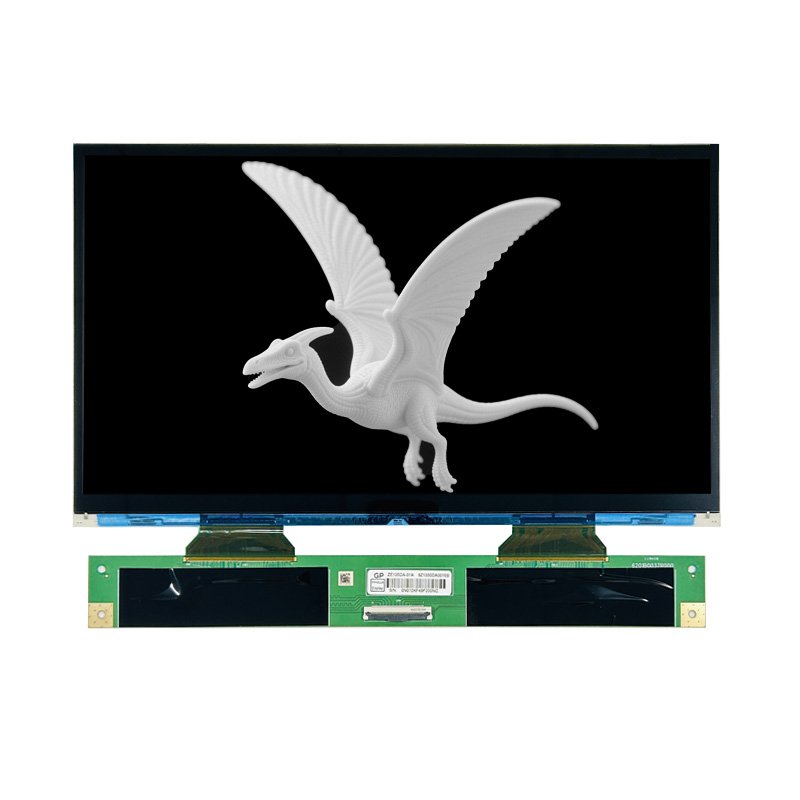
An example of this display category is the 14-inch 16K mono LCD screen.
Such displays are particularly well-suited for professional SLA printers used in labs and production environments where consistency across batches is essential.
UV Light Efficiency and Thermal Stability
Resolution alone is not enough. SLA printers operate under continuous UV exposure, which introduces thermal and photochemical stress on the LCD panel.
High-quality mono LCD screens designed for SLA applications typically feature:
- Enhanced UV resistance coatings
- Optimized liquid crystal materials for long-term stability
- Improved thermal management characteristics
These factors contribute to longer panel lifespan and more consistent printing performance over time. For users running printers in high-duty cycles—such as dental labs or service bureaus—panel durability directly impacts operating costs and machine uptime.
Application-Specific Benefits Across Industries
Dental and Medical Modeling
Dental SLA printing demands exceptional surface smoothness and dimensional accuracy. High-resolution mono LCD screens enable the reproduction of fine anatomical features such as cusps, margins, and internal geometries with minimal post-processing.
Jewelry and Precision Casting
Jewelry printing benefits from sharp edges and clean surface transitions, especially for filigree designs and micro-textured surfaces. Fine pixel control ensures accurate mold creation and reduces finishing work after casting.
Industrial Prototyping
For engineering prototypes, accuracy across large surface areas is critical. High-resolution mono LCD panels allow designers to validate form and fit before moving to CNC machining or injection molding.
Reliability and Consistency in Production Environments
In professional settings, repeatability is as important as raw resolution. Inconsistent masking or pixel degradation can lead to failed prints, material waste, and downtime.
Modern mono LCD screens engineered for SLA printing prioritize:
- Uniform luminance across the active area
- Stable pixel performance over extended operation
- Reduced risk of dead pixels or brightness falloff
These characteristics support consistent output, making mono LCD technology suitable not only for prototyping but also for low- to medium-volume production.
Considerations When Selecting a Mono LCD Screen for SLA Printers
When evaluating mono LCD screens for SLA applications, engineers and manufacturers should consider:
- Pixel size and effective resolution
- Panel size vs. build volume requirements
- UV transmission efficiency
- Thermal and mechanical stability
- Compatibility with light engine and optical stack design
Balancing these factors ensures that the display integrates seamlessly into the overall printer architecture.
Future Trends in SLA Display Technology
As SLA printers continue to evolve, display technology is expected to advance in several key areas:
- Even higher pixel densities for micro-scale printing
- Improved UV durability for extended service life
- Larger panels enabling industrial-scale resin printing
- Better integration with adaptive exposure and calibration systems
Mono LCD screens will remain a foundational component of these advancements, acting as the bridge between digital design data and physical printed objects.
Conclusion: Mono LCD Screens as a Core Enabler of SLA Innovation
High-resolution mono LCD screens are no longer just a component within SLA printers—they are a defining factor in print quality, scalability, and reliability. As the demand for precision resin printing grows across professional industries, display technology will continue to shape what is possible in additive manufacturing.
By combining ultra-high resolution, efficient UV transmission, and long-term stability, modern mono LCD panels enable SLA printers to achieve both scale and precision without compromise. For manufacturers and users alike, understanding the role of display technology is essential to unlocking the full potential of next-generation SLA 3D printing systems.