

How to Choose a Mono LCD for Industrial 3D Printers

Industrial resin 3D printing has evolved rapidly in recent years, driven by increasing demands for higher precision, faster production cycles, and long-term operational stability. At the core of many SLA and DLP-based industrial systems lies a critical component that directly affects print quality and productivity: the mono LCD display.
Choosing the right mono LCD for industrial 3D printers is not simply about selecting the highest resolution available. Industrial environments introduce additional requirements related to durability, interface compatibility, thermal stability, and long-term consistency. Understanding these factors is essential for system integrators, equipment manufacturers, and engineers working with industrial-grade 3D printing platforms.
Why Mono LCD Displays Dominate Industrial Resin 3D Printing
Mono LCD technology has largely replaced traditional RGB LCDs in professional and industrial resin printers. The reason is straightforward: mono LCD panels allow nearly 100% light transmission, whereas RGB LCDs block a significant portion of UV light due to color filters.
For industrial 3D printing, this translates into:
- Faster layer exposure times
- Higher printing efficiency
- Improved curing uniformity
- Longer panel lifespan under UV exposure
In production-focused environments, these advantages directly impact throughput and operating costs, making mono LCD screens the preferred choice for industrial resin printing systems.
Resolution Matters — But Only When Applied Correctly
High resolution is often the first specification discussed when selecting an industrial 3D printer LCD. While higher pixel density can improve surface detail, resolution must be evaluated together with screen size and optical system design.
A high resolution mono LCD with inadequate pixel alignment or mismatched optics may not deliver real-world benefits. Industrial printers typically require:
- Consistent pixel geometry across the entire build area
- Minimal pixel distortion at the edges
- Stable performance during extended print cycles
Ultra-high-resolution options, such as 16K mono LCD displays, are particularly suitable for large-format industrial printers where both precision and build volume are required simultaneously.
Screen Size and Build Volume Alignment
In industrial applications, the mono LCD size must be carefully matched to the printer’s build platform. Larger screens enable higher throughput by supporting larger build areas or multiple parts per print job.
However, increasing screen size without maintaining sufficient resolution can compromise fine detail. Industrial system designers often balance these factors by selecting large-format mono LCD panels with ultra-high pixel counts, ensuring that accuracy is preserved across the entire build surface.
Interface Compatibility: Why MIPI Matters
Interface selection is a frequently underestimated aspect when choosing a mono LCD for industrial systems. Many modern industrial printers rely on high-speed data transmission to support ultra-high-resolution displays.
The MIPI interface has become a common choice for industrial mono LCD displays due to:
- High bandwidth support for 8K and 16K resolutions
- Reduced signal interference
- Compact connector design suitable for dense system layouts
Ensuring proper compatibility between the LCD, control board, and firmware is critical for maintaining stable operation in continuous production environments.
Reliability and Lifespan in Industrial Environments
Unlike consumer-grade 3D printers, industrial machines often operate for extended periods with minimal downtime. This places greater demands on LCD durability and thermal stability.
Key reliability considerations include:
- Resistance to UV degradation
- Stable optical performance over time
- Heat dissipation under continuous exposure
- Consistent brightness across long operating cycles
Selecting an industrial-grade mono LCD helps minimize maintenance intervals and reduces the risk of unexpected production interruptions.
Optical Stack and Polarizer Selection
The performance of a mono LCD is also influenced by its optical stack, including polarizer films and glass substrates. Different polarizer configurations can affect contrast, light transmission efficiency, and curing accuracy.
In industrial resin printing, optimizing the optical stack ensures:
- Uniform exposure across the build plate
- Reduced light leakage between pixels
- Enhanced edge definition for complex geometries
These factors become increasingly important as resolution and build volume scale up.
Industrial Use Case Example: Large-Format SLA Systems
Large-format industrial SLA printers demand displays that combine high resolution, large active areas, and robust electrical interfaces. In such systems, a mono LCD screen for SLA printers must support consistent performance across thousands of print hours.
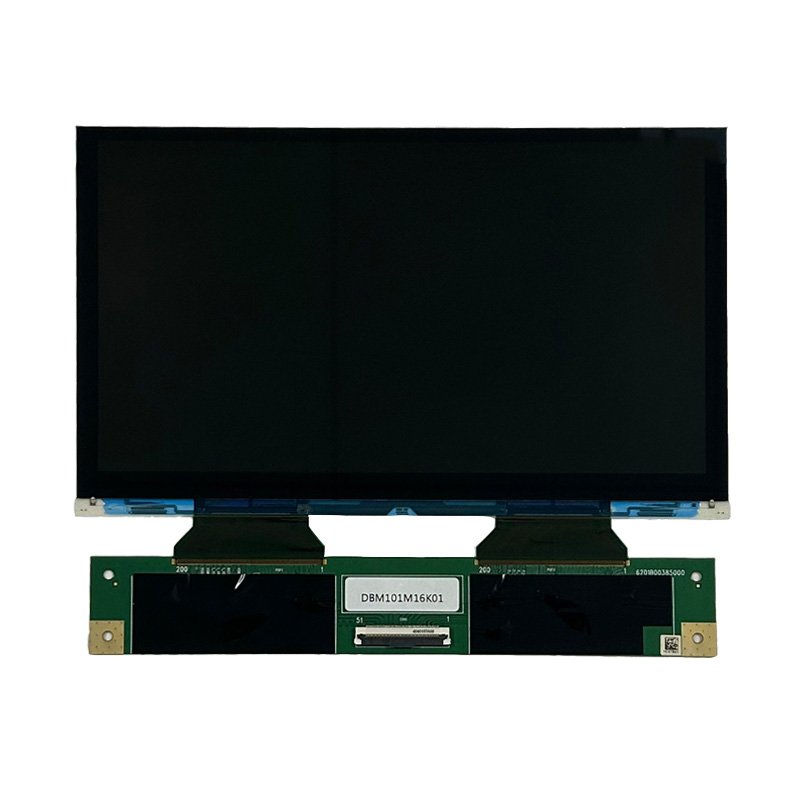
For example, a 10.1-inch 16K mono LCD with a MIPI interface is well suited for industrial printers that require fine detail reproduction without sacrificing productivity. Panels in this category are commonly integrated into professional systems designed for dental, medical modeling, and precision manufacturing workflows.
A practical reference for this class of application is a
10.1-inch 16K mono LCD display for industrial 3D printers, which illustrates how ultra-high resolution and industrial interface standards can be combined for demanding production environments.
Common Mistakes When Selecting Industrial Mono LCD Displays
Despite the availability of advanced display technology, selection mistakes still occur. Common issues include:
- Prioritizing resolution without considering optics
- Ignoring interface limitations of the control board
- Underestimating thermal management requirements
- Choosing consumer-grade panels for industrial workloads
Avoiding these pitfalls requires a system-level perspective rather than focusing on a single specification.
Final Considerations for Industrial System Designers
Selecting the right mono LCD for industrial 3D printers involves more than comparing datasheets. Resolution, size, interface, optical performance, and long-term reliability must all align with the intended application.
As industrial resin printing continues to expand into new sectors, display selection will remain a critical factor influencing print quality, productivity, and total cost of ownership. By evaluating mono LCD displays from a system integration perspective, manufacturers and engineers can build more reliable and scalable industrial 3D printing solutions.