

Mono LCD for Industrial 3D Printers: Performance Factors That Matter

Mono LCD for Industrial 3D Printers: Performance Factors That Matter
Industrial resin 3D printing systems are designed for consistency, accuracy, and long-term production stability. Unlike desktop machines, industrial platforms often operate continuously, producing functional parts where dimensional accuracy and surface quality are non-negotiable. At the heart of these systems is a critical optical component: the mono LCD display.
When evaluating a mono LCD for industrial 3D printers, performance must be assessed beyond basic specifications. Resolution, optical efficiency, interface stability, and long-term reliability all influence how effectively the display supports industrial-grade SLA and DLP printing workflows.
Understanding the Role of Mono LCD in Industrial Printing Systems
In industrial resin 3D printing, the mono LCD functions as a dynamic photomask, selectively allowing UV light to cure resin layer by layer. Compared to RGB LCD panels, mono LCDs offer significantly higher light transmittance, enabling faster exposure times and improved energy efficiency.
For industrial environments, these characteristics result in:
- Higher production throughput
- Reduced exposure-related heat buildup
- More uniform curing across large build areas
As a result, mono LCD technology has become the standard choice for professional and industrial resin printers.
Resolution Is Only Valuable When It Improves Output Quality
High resolution is often highlighted when discussing industrial 3D printer LCDs, but pixel count alone does not guarantee better print results. In practice, resolution must be considered in relation to optical alignment, lens quality, and exposure calibration.
A high resolution mono LCD can enhance edge sharpness and surface detail, but only if:
- Pixel uniformity is consistent across the panel
- The optical path maintains focus across the full build area
- Exposure settings are optimized for the specific resin system
Industrial systems typically benefit from ultra-high-resolution displays when printing complex geometries or fine-feature components at scale.
Large-Format Displays and Industrial Productivity
Industrial 3D printers often prioritize build volume and batch efficiency. Larger mono LCD panels enable wider exposure areas, allowing manufacturers to print multiple parts simultaneously or produce larger components in a single build.
However, increasing screen size introduces challenges related to signal integrity, thermal stability, and uniform brightness. This is why large-format industrial printers increasingly rely on advanced interfaces and carefully engineered display modules to maintain consistent performance.
The Importance of MIPI Interfaces in High-Resolution Systems
As display resolutions reach 8K and 16K levels, traditional LCD interfaces may struggle to handle the required data bandwidth. The MIPI interface has emerged as a preferred solution for industrial mono LCD displays due to its ability to transmit high-speed data with minimal signal loss.
For industrial systems, MIPI-based mono LCD displays offer:
- Stable image transmission at ultra-high resolutions
- Reduced electromagnetic interference
- Compact connectors suitable for dense control board layouts
These advantages make MIPI interfaces particularly suitable for modern industrial 3D printers that demand both speed and reliability.
Thermal Stability and Continuous Operation
One of the defining characteristics of industrial 3D printing is extended operational time. Displays in these systems may be exposed to UV light and elevated temperatures for thousands of hours over their service life.
Key considerations for thermal and operational stability include:
- Heat resistance of polarizer films
- Glass substrate durability
- Consistent brightness under prolonged exposure
A mono LCD designed for industrial use helps maintain predictable print quality while reducing the frequency of maintenance or component replacement.
Optical Stack Design and Light Efficiency
The optical stack of a mono LCD display—comprising polarizers, glass layers, and coatings—plays a crucial role in determining curing accuracy. Efficient light transmission improves resin exposure consistency, especially in high-speed industrial printing environments.
Optimized optical stacks help achieve:
- Reduced light diffusion between pixels
- Cleaner feature definition
- Improved layer-to-layer consistency
These factors are particularly important when producing precision components or functional prototypes with tight tolerances.
Application Example: High-Precision Industrial SLA Printing
In industrial SLA systems used for tooling, medical modeling, or engineering validation, display performance directly affects part accuracy and repeatability. A mono LCD screen for SLA printers must deliver uniform exposure across the entire build surface while maintaining fine pixel definition.
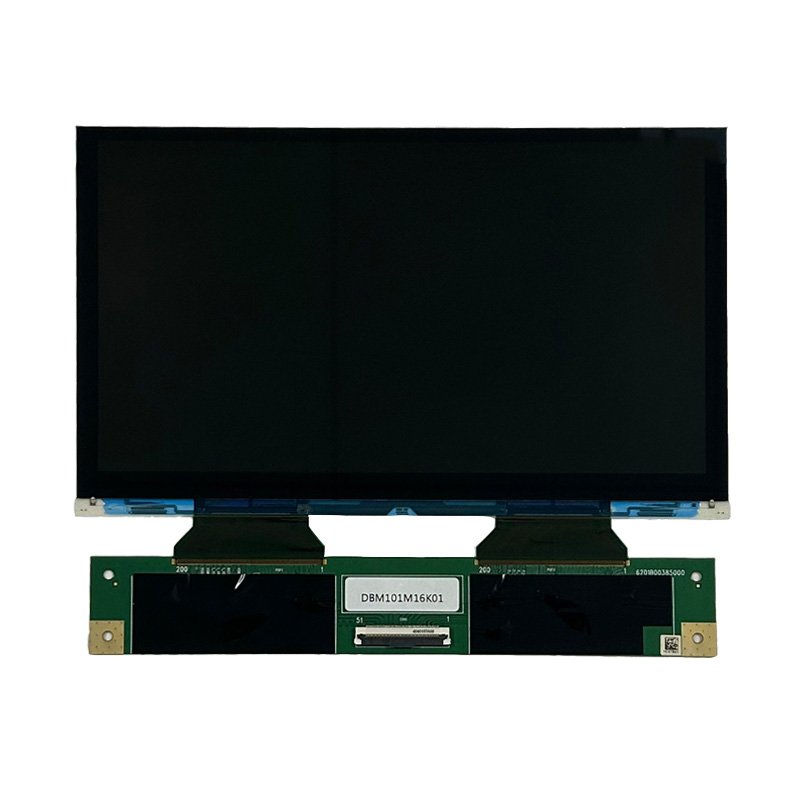
An example of this display category is a
high-resolution mono LCD display for industrial 3D printers, which demonstrates how ultra-high resolution, large active area, and MIPI interface compatibility can be combined for demanding industrial workflows.
Avoiding Performance Bottlenecks in Industrial Systems
Even advanced industrial printers can suffer performance issues if the display is not properly matched to the overall system design. Common challenges include:
- Interface bandwidth limitations
- Uneven brightness distribution
- Inadequate thermal management
- Mismatched exposure calibration
Addressing these factors at the display selection stage helps ensure long-term system stability and predictable production results.
Final Thoughts on Selecting Mono LCD Displays for Industrial Use
Choosing a mono LCD for industrial 3D printers is ultimately a system-level decision. While resolution and size are important, interface stability, optical efficiency, and durability under continuous operation are equally critical.
As industrial resin 3D printing continues to expand into production-oriented applications, the role of high-performance mono LCD displays will remain central to achieving reliable, repeatable results. Evaluating display performance from an engineering perspective enables manufacturers to build more robust and scalable industrial printing systems.